Analyzing the Motivations
Now that we have laid the groundwork in Episode One of this series and defined knowledge management, knowledge sharing and their dependencies on knowledge donation even when using facilitating technologies like Enterprise Social Media (ESM), we are ready to drill down further into the problem starting with understanding and analyzing the different types of motivations involved.
What is motivation?
As Ryan and Deci stated (2000a, p. 54), “to be motivated means to be moved to do something” . Motivation means being “energized or activated toward an end” (2000a, p. 54). There is more to it, however. Motivation comes in two flavors: intrinsic motivation and extrinsic motivation, depending on the actual causes behind it (Deci & Ryan, 2000).
To be more specific, intrinsic motivation exists within the individual. It is driven by an interest in or enjoyment of engaging in the target activity itself or enjoying performing it for others, without any external reward or incentive (Deci & Ryan, 2000). On the other hand, extrinsic motivation is the motivation towards an activity because of a desired outcome or a reward it leads to, or the desired goal behind it (Deci & Ryan, 2000).
So, what’s the difference?
What is important to know is that intrinsically motivated persons are more likely to perform the activity they are motivated about, which in turn helps improve their corresponding skills and, as such, positively impact their organization (Deci & Ryan, 2000). Intrinsic motivation is, therefore, driven by the enjoyment or the interest from within the individual and not as a result of seeking an external reward or incentive (Razmerita, Kirchner, & Nabeth, 2014). That is why those who are intrinsically motivated are more eager to perform the activity they are interested in and improve their skills in it (Deci & Ryan, 2000). Improving their skills improves their capabilities and therefore contributes to the improvement of their organization’s productivity. In contrast, extrinsically motivated people perform an activity to attain some separable outcome (Ryan & Deci, 2000b). That is, they need to be incentivized, pulled, or pushed to perform. No scholarly effort is necessary to deduce that this is not a self-sustainable motivation.
Understanding what is behind motivation
In many ways, motivations are part of our behavior. A behavioral theory can therefore help us understand more, especially one that is concerned with human motivations. The self-determination theory (SDT), a behavioral theory introduced by Ryan and Deci (2000b), is particularly applicable in this context because it uses the three basic human needs of autonomy, competence, and relatedness to explain human motivation while taking into consideration the differences between its two main types, intrinsic and extrinsic motivations.
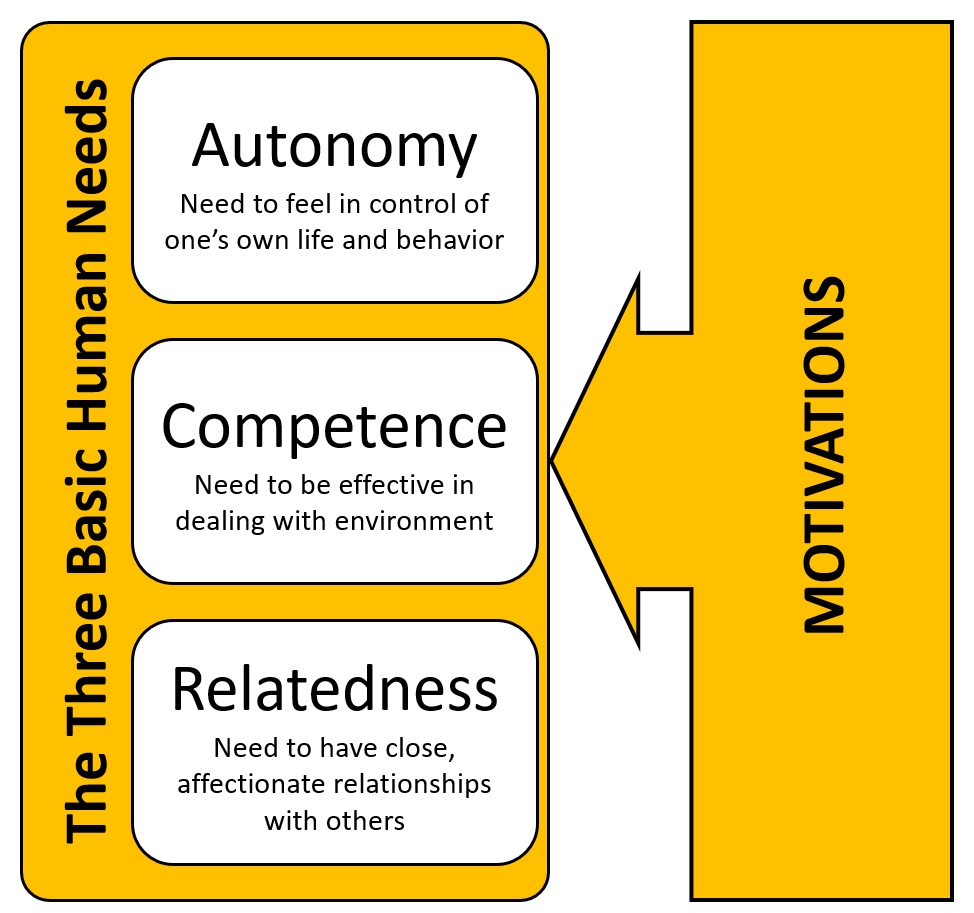
As illustrated above, SDT explains that humans’ behaviors are influenced by the intrinsic and extrinsic motivations we have described earlier. These motivations drive humans to satisfy the three needs of autonomy, competence, and relatedness, which SDT labels as basic human needs (Deci & Ryan, 2008). Humans need to feel in control of their life and behavior. That is the autonomy need (Ackerman, 2019). Humans also need to master skills and feel effective in dealing with their environment. That is the competence need (2019). Finally, humans need to have a sense of belonging and affectionate relatedness with other humans. That is the relatedness need (2019).
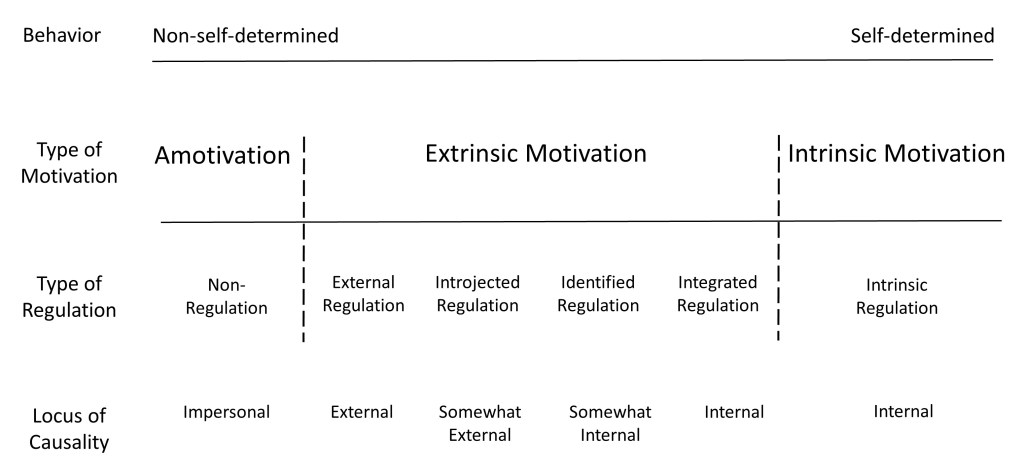
SDT goes further in its differentiation between the two types of motivation by defining a self-determination continuum consisting of several nuances of motivation varying from the non-self-determined extreme where humans are unmotivated (amotivation state), all the way to intrinsic motivation on the self-determined extreme, passing through increasing shades of extrinsic motivation (Ryan & Deci, 2000b).
Assembling the explanatory framework
In the study I have conducted to understand what are the intrinsic motivation factors affecting individuals’ will to share their knowledge on enterprise social media, I have combined and adapted those concepts introduced by SDT into the following conceptual framework through which the matter can be viewed and explained.
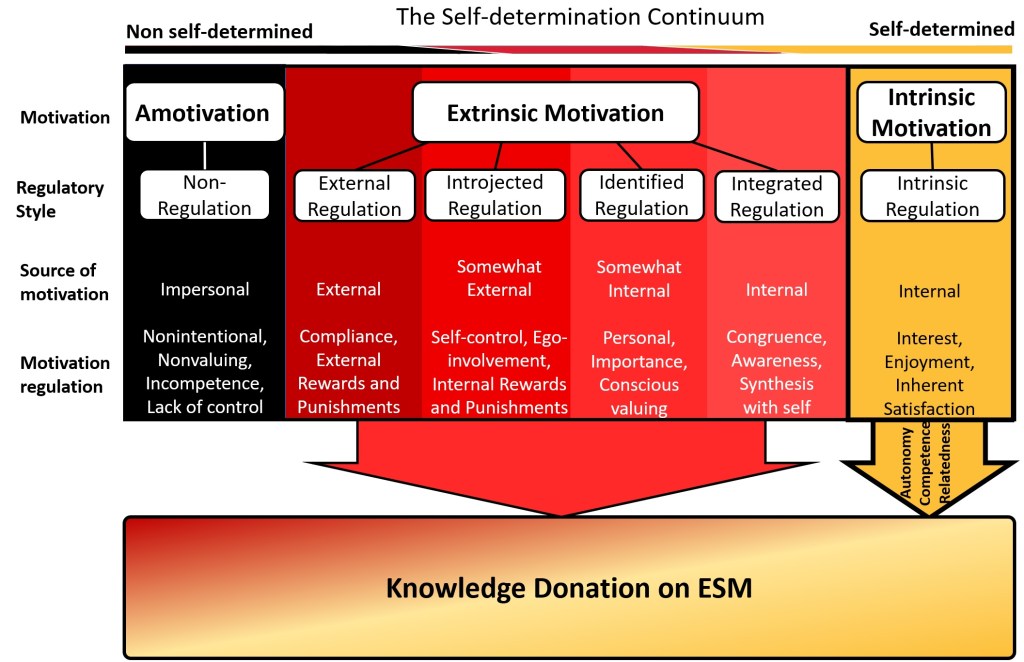
This conceptual framework helps us see that knowledge donation can be driven by extrinsic and intrinsic motivations. Furthermore, as we zoom into the intrinsic motivations that we are trying to understand, we can further discern three different types of intrinsic motivation driving factors in alignment with the three basic human needs of the SDT. Accordingly, knowledge donation can be affected by autonomy driven intrinsic motivation factors, competence driven intrinsic motivation factors, and relatedness or connectedness driven intrinsic motivation factors as the three labeled arrows above illustrate.
Stay with us…
In the next episode, we will use this conceptual framework to explain the findings revealed by the systematic review study conducted to understand those intrinsic motivation factors that can help organizations improve knowledge sharing using enterprise social media.
 Knowledge Management Today
One thought on “Knowledge Sharing on Enterprise Social Media – Episode Two”