The Findings

Building on the groundwork laid in Episode One and the theoretically-backed conceptual framework established in Episode Two of this series, this third episode explores and attempts to explain the intrinsic motivations that drive individuals to share their knowledge on enterprise social media within organizations.
The findings below are the outcome of a systematic review I have conducted to identify those intrinsic motivation factors, the main focus of this series of episodes. The systematic review screened 259 research papers on the subject, located through a systematic search of scholarly journals in academic databases. The screening and quality appraisal retained the best 20 of those studies in terms of relevance and quality of research. Finally, a two-cycle thematic coding helped extract and synthesize the essence and key findings of all those studies into the interesting observations and the evidence-based themes outlined below.
Interesting alignments
As you will notice below, the findings align nicely with the principles defined by the self-determination theory. That is, the 11 identified intrinsic motivation factors resonate with the three basic human needs which they aim to satisfy, as posited by the self-determination theory.
Alignment with the Autonomy Need
The majority of the identified intrinsic motivation factors align with the autonomy need. Specifically, they are the following factors:
- Altruism
- Desire to benefit the organization
- Enjoyment
- Interest/curiosity
- Self-confidence
- Self-efficacy
The following graph shows the number of studies that concurred on each of the above intrinsic motivation factors having a positive effect on knowledge sharing or, more specifically, knowledge donation.
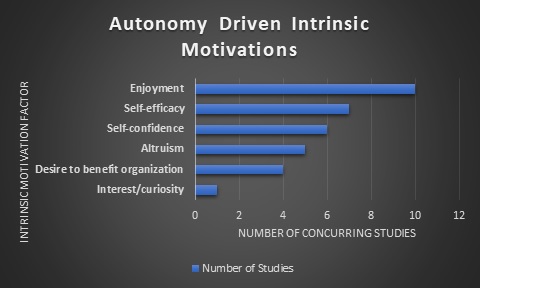
Effectively, enjoyment/satisfaction was found to be an intrinsic motivation factor that is positively related to knowledge sharing by 10 out of the 20 different studies analyzed (Aboelmaged, 2018; Chin, Evans, Choo, & Tan, 2015; Corcoran & Duane, 2017; Gagné, 2009; Hashim & Tan, 2015; Liu & Bakici, 2019; Meske, Junglas, & Stieglitz, 2019; Razmerita, Kirchner, & Nabeth, 2014; Rode, 2016). Self-efficacy, or more specifically knowledge self-efficacy, was next in line with seven out of the 20 studies finding that it is also an autonomy-need driven intrinsic motivation factor that is positively related to knowledge sharing (Behringer & Sassenberg, 2015; Chin, Evans, Choo, & Tan, 2015; Gagné, 2009; Liu & Rau, 2014; Liu & Bakici, 2019; Razmerita, Kirchner, & Nielsen, 2016; Rode, 2016; Suh & Wagner, 2017).
On the other hand, self-confidence, or rather the lack of self-confidence, was found to have an inhibiting effect on knowledge sharing. Individuals who lack self-confidence may fear being criticized by their peers if they share knowledge they are not confident about or not confident of its accuracy (Behringer & Sassenberg, 2015; Chin, Evans, Choo, & Tan, 2015; Leonardi, 2017; Liu & Rau, 2014; Razmerita, Kirchner, & Nielsen, 2016; Vuori & Okkonen, 2012). Organizations may need to promote safe and encouraging environments to help dissipate such fears and promote more knowledge sharing.
Five studies found that altruism or the enjoyment felt when helping others, was a significant intrinsic motivation factor with a positive relation to knowledge sharing (Chin, Evans, Choo, & Tan, 2015; Liu & Rau, 2014; Razmerita, Kirchner, & Nielsen, 2016; Vuori & Okkonen, 2012). Nevertheless, one study by Rode (2016) disagreed with that, stating no significant relationship between knowledge sharing and altruism. This opposing view may deserve further investigation or validation. Benefiting one’s own organization was equally found to be an intrinsic motivation factor that is positively associated with knowledge sharing by four studies (Fulk & Yuan, 2013; Gagné, 2009; Razmerita, Kirchner, & Nielsen, 2016; Vuori & Okkonen, 2012). This makes sense because this factor may be considered a specific form of altruism, which has also been shown to be positively related to knowledge sharing. Finally, Vuori and Okkonen also found that curiosity/interest is an important intrinsic motivation factor that is positively related to knowledge sharing on enterprise social media (2012, p. 598).
Alignment with the Competence Need
Still in alignment with the self-determination theory, four studies reported a relation between experience/familiarity and knowledge sharing on enterprise social media. On the one hand, the lack of familiarity/experience was found to be an inhibiting factor, while on the other hand, good familiarity/experience in enterprise social media was found to be positively associated with knowledge sharing (Behringer & Sassenberg, 2015; Chin, Evans, Choo, & Tan, 2015; Liu & Bakici, 2019; Vuori & Okkonen, 2012). Improving knowledge and improving work were also found to be positively related to knowledge sharing (Corcoran & Duane, 2017; Meske, Junglas, & Stieglitz, 2019; Razmerita, Kirchner, & Nielsen, 2016). Those factors are driven by the competence need.
Alignment with the Relatedness Need
As to the relatedness need, or the need of humans to have close and affectionate associations with other human beings, 13 studies found that association was positively related to knowledge sharing on enterprise social media. For instance, Fulk and Yuan noted a positive relationship between knowledge sharing on enterprise social media and the emotional closeness with colleagues (2013).
Furthermore, seven studies also noted that trust was related to knowledge sharing on enterprise social media (Fulk & Yuan, 2013; Gagné, 2009; Hashim & Tan, 2015; Pee, 2018; Razmerita, Kirchner, & Nielsen, 2016; Valdez, Brell, Schaar, & Ziefle, 2018; Vuori & Okkonen, 2012).
Still more to come…
In the next and final episode of this series, we will explore the implications of these findings while noting the limitations of this research and highlighting additional exploration areas that may help further strengthen our understanding of the topic.
Stay tuned…
References
Aboelmaged, M. G. (2018). Knowledge sharing through enterprise social network (ESN) systems: Motivational drivers and their impact on employees’ productivity. Journal of Knowledge Management, 22(2), 362-383. doi:10.1108/JKM-05-2017-0188
Behringer, N., & Sassenberg, K. (2015). Introducing social media for knowledge management: Determinants of employees’ intentions to adopt new tools. Computers in Human Behavior, 48, 290-296. doi:10.1016/j.chb.2015.01.069
Chin, C. P.-Y., Evans, N., Choo, K.-K. R., & Tan, F. B. (2015). What influences employees to use enterprise social networks? A socio-technical perspective. PACIS, (p. 54). Retrieved from https://pdfs.semanticscholar.org/f2f3/abb477750d485c6f4f298824f8388da7cc58.pdf
Corcoran, N., & Duane, A. (2017). Using enterprise social networks as a knowledge management tool in higher education. VINE: The Journal of Information & Knowledge Management Systems, 47(4), 555-570. doi:10.1108/VJIKMS-12-2016-0073
Fulk, J., & Yuan, Y. C. (2013). Location, motivation, and social capitalization via enterprise social networking. Journal of Computer-Mediated Communication(1), 20. doi:10.1111/jcc4.12033
Gagné, M. (2009, 7). A model of knowledge-sharing motivation. Human Resource Management, 48(4), 571-589. doi:10.1002/hrm.20298
Hashim, K. F., & Tan, F. B. (2015). The mediating role of trust and commitment on members’ continuous knowledge sharing intention: A commitment-trust theory perspective. International Journal of Information Management, 35(2), 145-151. doi:10.1016/j.ijinfomgt.2014.11.001
Leonardi, P. M. (2017). The social media revolution: Sharing and learning in the age of leaky knowledge. Information and Organization(1). doi:10.1016/j.infoandorg.2017.01.004
Liu, J., & Rau, P.-L. P. (2014). Impact of self-construal on choice of enterprise social media for knowledge sharing. Social Behavior and Personality: an international journal(7), 1077. doi:10.2224/sbp.2014.42.7.1077
Liu, Y., & Bakici, T. (2019). Enterprise social media usage: The motives and the moderating role of public social media experience. Computers in Human Behavior, 101, 163-172. doi:10.1016/j.chb.2019.07.029
Meske, C., Junglas, I., & Stieglitz, S. (2019). Explaining the emergence of hedonic motivations in enterprise social networks and their impact on sustainable user engagement: A four-drive perspective. Journal of Enterprise Information Management, 32(3), 436-456. doi:10.1108/JEIM-08-2018-0177
Pee, L. G. (2018). Affordances for sharing domain-specific and complex knowledge on enterprise social media. International Journal of Information Management, 43, 25-37. doi:10.1016/j.ijinfomgt.2018.05.006
Razmerita, L., Kirchner, K., & Nabeth, T. (2014). Social media in organizations: leveraging personal and collective knowledge processes. Journal of Organizational Computing and Electronic Commerce, 24, 74-93.
Razmerita, L., Kirchner, K., & Nielsen, P. (2016). What factors influence knowledge sharing in organizations? A social dilemma perspective of social media communication. Journal of Knowledge Management, 20(6), 1225-1246. doi:10.1108/JKM-03-2016-0112
Rode, H. (2016). To share or not to share: the effects of extrinsic and intrinsic motivations on knowledge-sharing in enterprise social media platforms. Journal of Information Technology (Palgrave Macmillan), 31(2), 152-165. doi:10.1057/jit.2016.8
Suh, A., & Wagner, C. (2017). How gamification of an enterprise collaboration system increases knowledge contribution: An affordance approach. Journal of Knowledge Management, 21(2), 416-431. doi:10.1108/JKM-10-2016-0429
Valdez, A. C., Brell, J., Schaar, A. K., & Ziefle, M. (2018). The diversity of why: A meta-analytical study of usage motivation in enterprise social networks. Universal Access in the Information Society, 17(3), 549-566. doi:10.1007/s10209-017-0561-9
Vuori, V., & Okkonen, J. (2012). Knowledge sharing motivational factors of using an intra-organizational social media platform. Journal of Knowledge Management, 16(4), 592-603. doi:10.1108/13673271211246167
 Knowledge Management Today
One thought on “Knowledge Sharing on Enterprise Social Media-Episode Three”