Unlocking Tacit Knowledge Sharing in Organizations through Enterprise Social Media

In today’s knowledge-driven economy, organizations are constantly seeking ways to harness the collective expertise of their workforce. While explicit knowledge—such as documented processes, reports, and manuals—is relatively easy to capture and disseminate, tacit knowledge remains elusive. Tacit knowledge includes the unwritten, experience-based insights that employees accumulate over time, such as best practices, problem-solving skills, and intuitive decision-making.

One of the most effective yet underutilized tools for tacit knowledge sharing is Enterprise Social Media (ESM). Platforms like Microsoft Viva Engage (formerly Yammer), Workplace by Meta, Slack, and Microsoft Teams are not just communication channels—they can serve as dynamic ecosystems where tacit knowledge naturally emerges, flows, and enhances organizational intelligence.

  • Encouraging peer recognition through likes, badges, and kudos.
  • Embedding gamification, where contributors earn reputation points for valuable knowledge-sharing.
  • Promoting a collaborative culture, making knowledge-sharing an expected and rewarded behavior.

The Challenge of Tacit Knowledge Sharing

Tacit knowledge is deeply personal and context-specific, making it difficult to document and transfer. Employees often share it informally through mentoring, storytelling, and peer interactions. However, in today’s distributed workplaces, reliance on face-to-face communication alone is no longer viable.

Traditional knowledge management systems (KMS) fall short because they focus primarily on codified knowledge rather than experiential insights. This gap can lead to knowledge silos, expertise drain (due to turnover), and inefficiencies in decision-making.

How Enterprise Social Media Enhances Tacit Knowledge Sharing

ESM platforms provide a real-time digital environment where employees can engage in real-time as well as asynchronous conversations, share experiences, and collaborate organically on all sorts of tasks, problems, information exchanges, all of which often involve in depth expertise and experiences that are shared by the participants of the conversation thread or group, and where more often than not, the shared information is highly individual based on the collaborators past experience, skill, and involvement in the specific problem or area being discussed, which is mainly tacit information that is otherwise not documented anywhere else usually. ESMs can facilitate such tacit knowledge flows and exchanges in several ways:

  1. Enabling Organic Knowledge Exchange

Unlike rigid knowledge management systems, ESM fosters natural and informal discussions where employees can share their expertise freely. Through threads, comments, and reactions, teams can engage in problem-solving dialogues that capture implicit insights.

Example:
A senior engineer facing a complex troubleshooting issue posts a question on the company’s Microsoft Viva Engage group. Within hours, peers across different locations contribute insights, offering potential solutions based on past experiences, not just documented procedures.

  1. Creating a Culture of Knowledge Contribution

Organizations often struggle with knowledge hoarding, where employees hesitate to share insights due to concerns about job security or relevance. ESM addresses this by:

Example:
A company using Workplace by Meta recognizes employees who actively contribute insights in knowledge-sharing groups, awarding them with badges that highlight their expertise in specific areas.

  1. Capturing Insights Through Multimedia

Tacit knowledge isn’t always best expressed in text. ESM platforms allow employees to share:

  • Short video demos (e.g., quick troubleshooting guides).
  • Voice messages (to explain complex topics naturally).
  • Screenshots & annotated images (for contextual clarity).
  • Live Q&A sessions and webinars (where experts share experiences in real-time).

Example:
A customer support team in a global enterprise uses Slack to upload short explainer videos detailing how they handle specific client objections, helping new employees learn nuanced customer interactions.

  1. Encouraging Cross-Functional Collaboration

Tacit knowledge often exists in departmental silos, limiting its reach. ESM platforms break down barriers by enabling inter-departmental discussions where expertise flows beyond formal hierarchies.

Example:
A marketing team in a fast-moving consumer goods company collaborates with product designers on Microsoft Teams. By openly discussing customer feedback in a shared channel, designers gain real-time insights into user pain points—insights that may not have been captured in structured reports.

  1. Leveraging AI for Knowledge Discovery

Modern ESM platforms integrate AI-driven recommendations to surface relevant discussions, insights, and expertise, which includes powerful features such as:

  • Auto-tagging & smart search, allowing employees to find related conversations effortlessly.
  • AI-powered knowledge hubs, where frequently asked questions automatically compile into knowledge bases.

Example:
A financial services firm uses an AI-powered bot in Teams that indexes past expert discussions, enabling employees to retrieve previous solutions without repeating the same queries.

Best Practices for Implementing ESM for Tacit Knowledge Sharing

To maximize the effectiveness of ESM for tacit knowledge sharing, organizations should:

  • Establish Knowledge-Sharing Communities

    Create dedicated ESM groups or channels focused on expertise exchange in specific domains, such as:

    “Tech Troubleshooting Hub” (for IT teams)

    “Sales Success Stories” (for sharing customer insights)

    “Innovation Think Tank” (for R&D collaboration)

    • Encourage Leadership Participation

      When executives and senior experts actively engage in knowledge-sharing discussions, employees feel more encouraged to contribute.

      • Balance Open & Private Discussions

        While open forums encourage broad knowledge exchange, private groups can create safe spaces for employees to ask questions without hesitation.

        • Monitor & Measure Engagement

          Use ESM analytics to track:

          Participation levels (e.g., active contributors vs. passive viewers).

          Engagement metrics (e.g., likes, shares, and comments).

          Impact on problem resolution speed (e.g., how quickly knowledge is applied).

          • Integrate ESM with Knowledge Repositories

            Link ESM discussions to formal knowledge bases (e.g., SharePoint, Confluence) to ensure valuable insights don’t get lost over time.

            Conclusion: Transforming Tacit Knowledge into Organizational Intelligence

            By leveraging Enterprise Social Media, organizations can unlock, share, and scale tacit knowledge in ways that traditional knowledge management systems cannot. ESM bridges the gap between structured documentation and human expertise, fostering a continuous learning environment where experience flows seamlessly across teams.

            With today’s digital-first and remote workforces, embracing ESM as a core knowledge-sharing strategy is no longer optional—it’s a competitive advantage. Organizations that successfully cultivate social learning ecosystems will be better equipped to adapt, innovate, and sustain institutional expertise, ensuring that valuable tacit knowledge remains within the organization, even as employees come and go.


            Knowledge Sharing on Enterprise Social Media-Episode Four

            Practical Implications

            This fourth and last episode of the series builds on the previous three, and in particular, on the findings detailed in Episode Three, to explore the practical implications of those findings and provide helpful recommendations where possible. This episode also summarizes the limitations of this research and suggests additional future research to help bridge those gaps and limitations.

            Knowledge is the only treasure that increases when shared. Unknown

            So, what are the implications?

            Knowing about those 11 intrinsic motivation factors highlighted in the evidence identified by this research, can organizations do something to further promote knowledge sharing on enterprise social media and encourage individuals to donate their knowledge? Organizations should definitely attempt to leverage those factors since knowledge donation is a key success factor of knowledge management (Du, Ai, & Ren, 2007), and the success of knowledge management helps organizations maintain their competitive advantage (Rahimli, 2012).

            Promoting organizational cultures and supportive environments that nurture those motivating factors and encouraging the corresponding behaviors in individuals within the organization is one such initiative that organizations could consider implementing. For example, management could value, support, and encourage knowledge-sharing behaviors on the organization’s enterprise social media. As such, managers can play an instrumental role in dissipating knowledge management barriers and shaping a supportive organizational culture that embraces and encourages knowledge sharing (Hung et al., 2011 as cited in Razmerita, Kirchner, & Nielsen, 2016).

            Incorporating knowledge-sharing behavior indicators or measurements into performance appraisals that are designed with a developmental focus rather than an evaluative focus is another way of enhancing intrinsically motivated knowledge sharing (Gagné, 2009). Developmentally focused appraisals have been shown to enhance intrinsic motivation as well as performance (Kuvaas, 2007 as cited in Gagné, 2009).

            One additional example involves training. Delivering training that promotes sharing norms endorsement and shows employees how to share effectively may affect employees’ knowledge-sharing behavior in a positive manner (Gagné, 2009).

            Organizations can also leverage the relatedness driven intrinsic motivations. One example of that involves cultivating a productive social environment that supports both individual and organizational goals while encouraging participation and appropriate interactions. This can help strengthen relationships among individuals within the organization. Another example involves recognizing individuals who are motivated to share on the organization’s enterprise social media and promoting them as early adopters of the platform to encourage their colleagues’ engagement and knowledge sharing (Shaarawy & Abdelghaffar, 2017).

            Leaders and managers can also engage and communicate on the enterprise social media, thus providing social cues with a direct effect on how the individual network members act in response to new information (Fulk, 1993). This is known to affect team members’ acceptance and use of the enterprise social media, which will consequently affect the success of knowledge sharing on it (Ellison, Gibbs, & Weber, 2015).

            Possible Limitations

            Although this study collected and screened 259 research articles, the 20 retained articles that were included in this systematic review, may constitute a relatively limited total number of studies, which may have correspondingly limited the findings. Equally, the number of studies within the meta-analyses or systematic review studies included, and the sample sizes of the included primary research studies may limit the generalizability of the findings. Also, in spite of the rigorous measures applied during the study to maintain transparency and avoid bias, it is not impossible that some residual bias may exist in any of the included studies or in the systematic review itself.

            Suggestions for Future Research

            As such, encompassing more and larger studies in future research would help improve the findings. Further research may also look into identifying extrinsic motivation factors that positively affect knowledge sharing on enterprise social media. Future research may also examine additional organizational, cultural, and leadership factors that could cultivate the intrinsic motivation factors identified in this study. Finally, and in view of the conflicting finding of Rode (2016), who noted no significant relationship between altruism and knowledge sharing, it would be helpful to verify this finding in order to understand why Rode contradicted the many other researchers who found evidence of a positive relationship between altruism and knowledge sharing on enterprise social media within organizations.

            More in the making

            This fourth episode concludes in the hope that this series has helped provide an interesting, informative, and easy to read and understand overview of knowledge management and how organizations can leverage intrinsic motivation factors in human behavior to promote the success of knowledge management initiatives. Although this is the last episode of this series, there are other equally interesting and informative blog posts in the works. In the meantime, your comments, thoughts, and feedback are highly appreciated.

                                                                                                                        Stay tuned…

            References

            Du, R., Ai, S., & Ren, Y. (2007). Relationship between knowledge sharing and performance: A survey in Xi’an, China. Expert Systems With Applications, 32, 38-46. Retrieved from http://ezproxy.umuc.edu/login?url=https://search.ebscohost.com/login.aspx?direct=true&db=edselp&AN=S0957417405003052&site=eds-live&scope=site

            Ellison, N. B., Gibbs, J. L., & Weber, M. S. (2015). The use of enterprise social network sites for knowledge sharing in distributed organizations: The role of organizational affordances. American Behavioral Scientist, 59(1), 103-123.

            Fulk, J. (1993, 10). Social construction of communication technology. Academy of Management Journal, 36, 921-950. doi:10.2307/256641

            Gagné, M. (2009, 7). A model of knowledge-sharing motivation. Human Resource Management, 48(4), 571-589. doi:10.1002/hrm.20298

            Rahimli, A. (2012). Knowledge management and competitive advantage. Information and Knowledge Management, 2, pp. 37-43.

            Razmerita, L., Kirchner, K., & Nielsen, P. (2016). What factors influence knowledge sharing in organizations? A social dilemma perspective of social media communication. Journal of Knowledge Management, 20(6), 1225-1246. doi:10.1108/JKM-03-2016-0112

            Rode, H. (2016). To share or not to share: the effects of extrinsic and intrinsic motivations on knowledge-sharing in enterprise social media platforms. Journal of Information Technology (Palgrave Macmillan), 31(2), 152-165. doi:10.1057/jit.2016.8

            Shaarawy, N., & Abdelghaffar, H. (2017). Achieving successful knowledge sharing through enterprise social network collaboration. The Business & Management Review, 8(5), 1-15.

            Knowledge Sharing on Enterprise Social Media-Episode Three

            The Findings

            Photo by Nine Köpfer on Unsplash

            Building on the groundwork laid in Episode One and the theoretically-backed conceptual framework established in Episode Two of this series, this third episode explores and attempts to explain the intrinsic motivations that drive individuals to share their knowledge on enterprise social media within organizations.

            The findings below are the outcome of a systematic review I have conducted to identify those intrinsic motivation factors, the main focus of this series of episodes. The systematic review screened 259 research papers on the subject, located through a systematic search of scholarly journals in academic databases. The screening and quality appraisal retained the best 20 of those studies in terms of relevance and quality of research. Finally, a two-cycle thematic coding helped extract and synthesize the essence and key findings of all those studies into the interesting observations and the evidence-based themes outlined below.

            Interesting alignments

            As you will notice below, the findings align nicely with the principles defined by the self-determination theory. That is, the 11 identified intrinsic motivation factors resonate with the three basic human needs which they aim to satisfy, as posited by the self-determination theory.

            Alignment with the Autonomy Need

            The majority of the identified intrinsic motivation factors align with the autonomy need. Specifically, they are the following factors:

            • Altruism
            • Desire to benefit the organization
            • Enjoyment
            • Interest/curiosity
            • Self-confidence
            • Self-efficacy

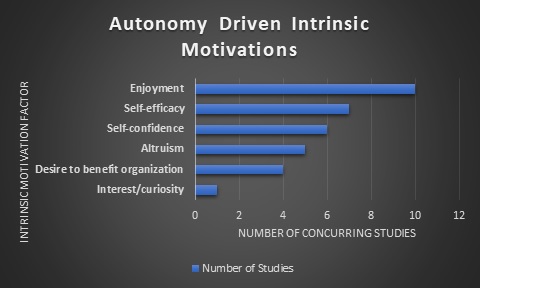
            The following graph shows the number of studies that concurred on each of the above intrinsic motivation factors having a positive effect on knowledge sharing or, more specifically, knowledge donation.

            Number of studies concurring with each of the 6 identified autonomy driven intrinsic motivation factors

            Effectively, enjoyment/satisfaction was found to be an intrinsic motivation factor that is positively related to knowledge sharing by 10 out of the 20 different studies analyzed (Aboelmaged, 2018; Chin, Evans, Choo, & Tan, 2015; Corcoran & Duane, 2017; Gagné, 2009; Hashim & Tan, 2015; Liu & Bakici, 2019; Meske, Junglas, & Stieglitz, 2019; Razmerita, Kirchner, & Nabeth, 2014; Rode, 2016). Self-efficacy, or more specifically knowledge self-efficacy, was next in line with seven out of the 20 studies finding that it is also an autonomy-need driven intrinsic motivation factor that is positively related to knowledge sharing (Behringer & Sassenberg, 2015; Chin, Evans, Choo, & Tan, 2015; Gagné, 2009; Liu & Rau, 2014; Liu & Bakici, 2019; Razmerita, Kirchner, & Nielsen, 2016; Rode, 2016; Suh & Wagner, 2017).

            On the other hand, self-confidence, or rather the lack of self-confidence, was found to have an inhibiting effect on knowledge sharing. Individuals who lack self-confidence may fear being criticized by their peers if they share knowledge they are not confident about or not confident of its accuracy (Behringer & Sassenberg, 2015; Chin, Evans, Choo, & Tan, 2015; Leonardi, 2017; Liu & Rau, 2014; Razmerita, Kirchner, & Nielsen, 2016; Vuori & Okkonen, 2012). Organizations may need to promote safe and encouraging environments to help dissipate such fears and promote more knowledge sharing.

            Five studies found that altruism or the enjoyment felt when helping others, was a significant intrinsic motivation factor with a positive relation to knowledge sharing (Chin, Evans, Choo, & Tan, 2015; Liu & Rau, 2014; Razmerita, Kirchner, & Nielsen, 2016; Vuori & Okkonen, 2012). Nevertheless, one study by Rode (2016) disagreed with that, stating no significant relationship between knowledge sharing and altruism. This opposing view may deserve further investigation or validation.  Benefiting one’s own organization was equally found to be an intrinsic motivation factor that is positively associated with knowledge sharing by four studies (Fulk & Yuan, 2013; Gagné, 2009; Razmerita, Kirchner, & Nielsen, 2016; Vuori & Okkonen, 2012). This makes sense because this factor may be considered a specific form of altruism, which has also been shown to be positively related to knowledge sharing. Finally, Vuori and Okkonen also found that curiosity/interest is an important intrinsic motivation factor that is positively related to knowledge sharing on enterprise social media (2012, p. 598).

            Alignment with the Competence Need

            Still in alignment with the self-determination theory, four studies reported a relation between experience/familiarity and knowledge sharing on enterprise social media. On the one hand, the lack of familiarity/experience was found to be an inhibiting factor, while on the other hand, good familiarity/experience in enterprise social media was found to be positively associated with knowledge sharing (Behringer & Sassenberg, 2015; Chin, Evans, Choo, & Tan, 2015; Liu & Bakici, 2019; Vuori & Okkonen, 2012). Improving knowledge and improving work were also found to be  positively related to knowledge sharing (Corcoran & Duane, 2017; Meske, Junglas, & Stieglitz, 2019; Razmerita, Kirchner, & Nielsen, 2016). Those factors are driven by the competence need.

            Alignment with the Relatedness Need

            As to the relatedness need, or the need of humans to have close and affectionate associations with other human beings, 13 studies found that association was positively related to knowledge sharing on enterprise social media. For instance, Fulk and Yuan noted a positive relationship between knowledge sharing on enterprise social media and the emotional closeness with colleagues (2013).

            Furthermore, seven studies also noted that trust was related to knowledge sharing on enterprise social media  (Fulk & Yuan, 2013; Gagné, 2009; Hashim & Tan, 2015; Pee, 2018; Razmerita, Kirchner, & Nielsen, 2016; Valdez, Brell, Schaar, & Ziefle, 2018; Vuori & Okkonen, 2012). 

            Still more to come

            In the next and final episode of this series, we will explore the implications of these findings while noting the limitations of this research and highlighting additional exploration areas that may help further strengthen our understanding of the topic.

                                                                                                                        Stay tuned…

            References

            Aboelmaged, M. G. (2018). Knowledge sharing through enterprise social network (ESN) systems: Motivational drivers and their impact on employees’ productivity. Journal of Knowledge Management, 22(2), 362-383. doi:10.1108/JKM-05-2017-0188

            Behringer, N., & Sassenberg, K. (2015). Introducing social media for knowledge management: Determinants of employees’ intentions to adopt new tools. Computers in Human Behavior, 48, 290-296. doi:10.1016/j.chb.2015.01.069

            Chin, C. P.-Y., Evans, N., Choo, K.-K. R., & Tan, F. B. (2015). What influences employees to use enterprise social networks? A socio-technical perspective. PACIS, (p. 54). Retrieved from https://pdfs.semanticscholar.org/f2f3/abb477750d485c6f4f298824f8388da7cc58.pdf

            Corcoran, N., & Duane, A. (2017). Using enterprise social networks as a knowledge management tool in higher education. VINE: The Journal of Information & Knowledge Management Systems, 47(4), 555-570. doi:10.1108/VJIKMS-12-2016-0073

            Fulk, J., & Yuan, Y. C. (2013). Location, motivation, and social capitalization via enterprise social networking. Journal of Computer-Mediated Communication(1), 20. doi:10.1111/jcc4.12033

            Gagné, M. (2009, 7). A model of knowledge-sharing motivation. Human Resource Management, 48(4), 571-589. doi:10.1002/hrm.20298

            Hashim, K. F., & Tan, F. B. (2015). The mediating role of trust and commitment on members’ continuous knowledge sharing intention: A commitment-trust theory perspective. International Journal of Information Management, 35(2), 145-151. doi:10.1016/j.ijinfomgt.2014.11.001

            Leonardi, P. M. (2017). The social media revolution: Sharing and learning in the age of leaky knowledge. Information and Organization(1). doi:10.1016/j.infoandorg.2017.01.004

            Liu, J., & Rau, P.-L. P. (2014). Impact of self-construal on choice of enterprise social media for knowledge sharing. Social Behavior and Personality: an international journal(7), 1077. doi:10.2224/sbp.2014.42.7.1077

            Liu, Y., & Bakici, T. (2019). Enterprise social media usage: The motives and the moderating role of public social media experience. Computers in Human Behavior, 101, 163-172. doi:10.1016/j.chb.2019.07.029

            Meske, C., Junglas, I., & Stieglitz, S. (2019). Explaining the emergence of hedonic motivations in enterprise social networks and their impact on sustainable user engagement: A four-drive perspective. Journal of Enterprise Information Management, 32(3), 436-456. doi:10.1108/JEIM-08-2018-0177

            Pee, L. G. (2018). Affordances for sharing domain-specific and complex knowledge on enterprise social media. International Journal of Information Management, 43, 25-37. doi:10.1016/j.ijinfomgt.2018.05.006

            Razmerita, L., Kirchner, K., & Nabeth, T. (2014). Social media in organizations: leveraging personal and collective knowledge processes. Journal of Organizational Computing and Electronic Commerce, 24, 74-93.

            Razmerita, L., Kirchner, K., & Nielsen, P. (2016). What factors influence knowledge sharing in organizations? A social dilemma perspective of social media communication. Journal of Knowledge Management, 20(6), 1225-1246. doi:10.1108/JKM-03-2016-0112

            Rode, H. (2016). To share or not to share: the effects of extrinsic and intrinsic motivations on knowledge-sharing in enterprise social media platforms. Journal of Information Technology (Palgrave Macmillan), 31(2), 152-165. doi:10.1057/jit.2016.8

            Suh, A., & Wagner, C. (2017). How gamification of an enterprise collaboration system increases knowledge contribution: An affordance approach. Journal of Knowledge Management, 21(2), 416-431. doi:10.1108/JKM-10-2016-0429

            Valdez, A. C., Brell, J., Schaar, A. K., & Ziefle, M. (2018). The diversity of why: A meta-analytical study of usage motivation in enterprise social networks. Universal Access in the Information Society, 17(3), 549-566. doi:10.1007/s10209-017-0561-9

            Vuori, V., & Okkonen, J. (2012). Knowledge sharing motivational factors of using an intra-organizational social media platform. Journal of Knowledge Management, 16(4), 592-603. doi:10.1108/13673271211246167

            Knowledge Sharing on Enterprise Social Media – Episode Two

            Analyzing the Motivations

            Now that we have laid the groundwork in Episode One of this series and defined knowledge management, knowledge sharing and their dependencies on knowledge donation even when using facilitating technologies like Enterprise Social Media (ESM), we are ready to drill down further into the problem  starting with understanding and analyzing the different types of motivations involved.

            What is motivation?

            As Ryan and Deci stated (2000a, p. 54), “to be motivated means to be moved to do something” . Motivation means being “energized or activated toward an end” (2000a, p. 54).  There is more to it, however.  Motivation comes in two flavors: intrinsic motivation and extrinsic motivation, depending on the actual causes behind it (Deci & Ryan, 2000).

            To be more specific, intrinsic motivation exists within the individual. It is driven by an interest in or enjoyment of engaging in the target activity itself or enjoying performing it for others, without any external reward or incentive (Deci & Ryan, 2000). On the other hand, extrinsic motivation is the motivation towards an activity because of a desired outcome or a reward it leads to, or the desired goal behind it (Deci & Ryan, 2000).

            So, what’s the difference?

            What is important to know is that intrinsically motivated persons are more likely to perform the activity they are motivated about, which in turn helps improve their corresponding skills and, as such, positively impact their organization (Deci & Ryan, 2000). Intrinsic motivation is, therefore, driven by the enjoyment or the interest from within the individual and not as a result of seeking an external reward or incentive (Razmerita, Kirchner, & Nabeth, 2014). That is why those who are intrinsically motivated are more eager to perform the activity they are interested in and improve their skills in it (Deci & Ryan, 2000). Improving their skills improves their capabilities and therefore contributes to the improvement of their organization’s productivity. In contrast, extrinsically motivated people perform an activity to attain some separable outcome (Ryan & Deci, 2000b).  That is, they need to be incentivized, pulled, or pushed to perform.  No scholarly effort is necessary to deduce that this is not a self-sustainable motivation. 

            Understanding what is behind motivation

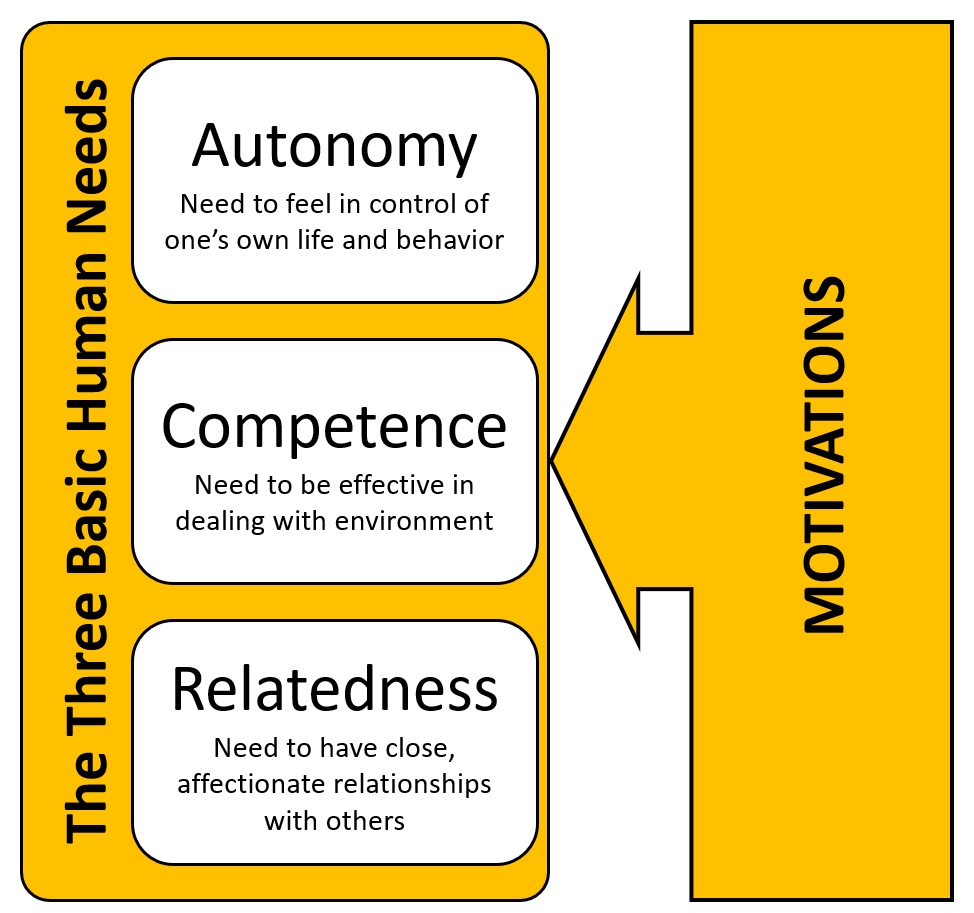
            In many ways, motivations are part of our behavior. A behavioral theory can therefore help us understand more, especially one that is concerned with human motivations. The self-determination theory (SDT), a behavioral theory introduced by Ryan and Deci (2000b), is particularly applicable in this context because it uses the three basic human needs of autonomy, competence, and relatedness to explain human motivation while taking into consideration the differences between its two main types, intrinsic and extrinsic motivations.  

            The self-determination theory posits that three basic human needs drive human motivations. Adapted from “Self-Determination Theory of Motivation: Why Intrinsic Motivation Matters,” by C. E. Ackerman, 2019 (https://positivepsychology.com/self-determination-theory/).

            As illustrated above, SDT explains that humans’ behaviors are influenced by the intrinsic and extrinsic motivations we have described earlier. These motivations drive humans to satisfy the three needs of autonomy, competence, and relatedness, which SDT labels as basic human needs (Deci & Ryan, 2008). Humans need to feel in control of their life and behavior. That is the autonomy need (Ackerman, 2019). Humans also need to master skills and feel effective in dealing with their environment. That is the competence need (2019). Finally, humans need to have a sense of belonging and affectionate relatedness with other humans. That is the relatedness need (2019).

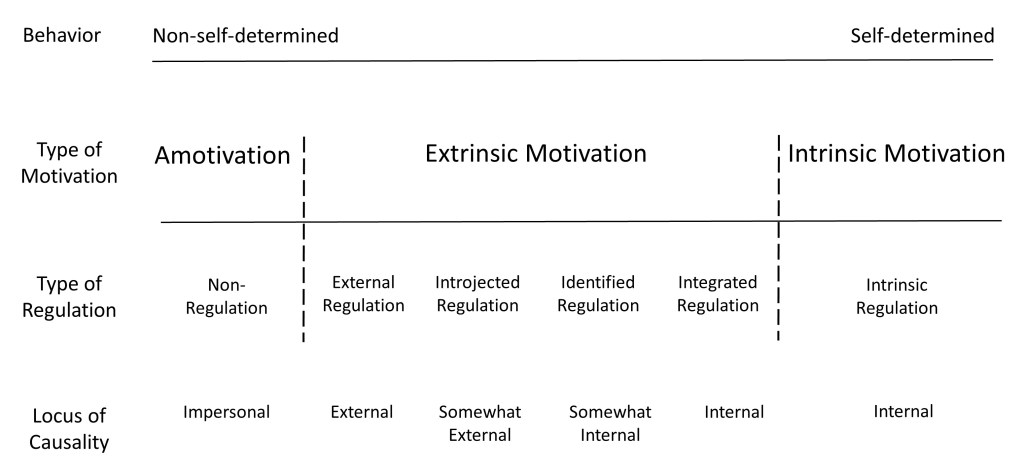
            SDT goes further in its differentiation between the two types of motivation by defining a self-determination continuum consisting of several nuances of motivation varying from the non-self-determined extreme where humans are unmotivated (amotivation state), all the way to intrinsic motivation on the self-determined extreme, passing through increasing shades of extrinsic motivation (Ryan & Deci, 2000b).

            The self-determination continuum explains that motivation types range from amotivation, through decreasing degrees of extrinsic motivation, to intrinsic motivation. Reprinted from “The What and Why of Goal Pursuits: Human Needs and the Self-Determination of Behavior,” by E. L. Deci and R. M. Ryan, 2000, Psychological Inquiry, 11(4), 237. Copyright 2000 by Lawrence Erlbaum Associates, Inc.

            Assembling the explanatory framework

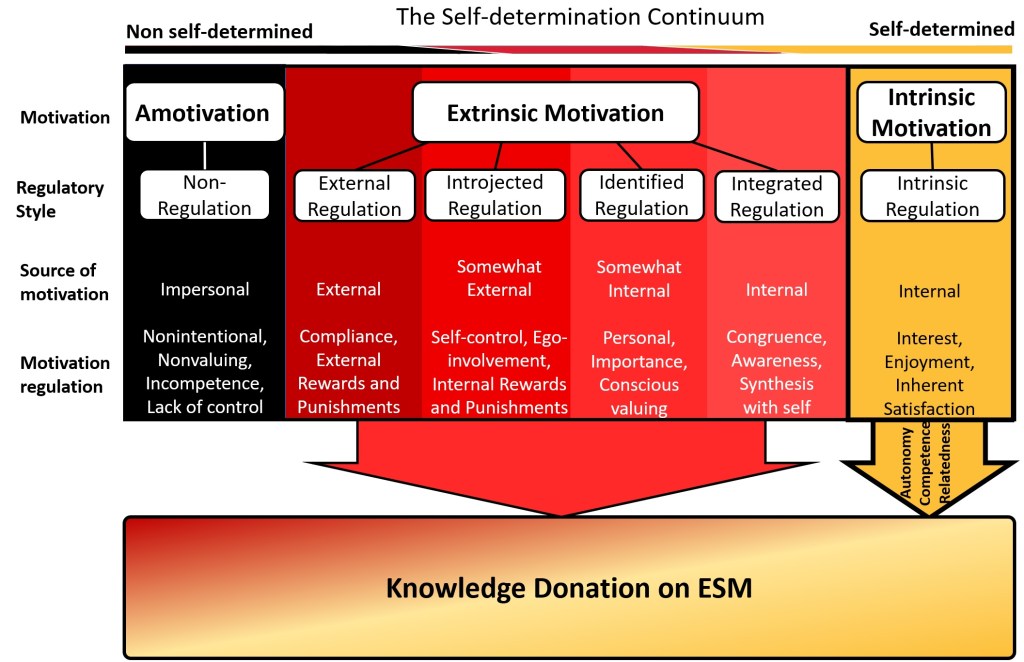
            In the study I have conducted to understand what are the intrinsic motivation factors affecting individuals’ will to share their knowledge on enterprise social media, I have combined and adapted those concepts introduced by SDT into the following conceptual framework through which the matter can be viewed and explained.

            The conceptual framework. Adapted from Ryan and Deci, 2000a

            This conceptual framework helps us see that knowledge donation can be driven by extrinsic and intrinsic motivations. Furthermore, as we zoom into the intrinsic motivations that we are trying to understand, we can further discern three different types of intrinsic motivation driving factors in alignment with the three basic human needs of the SDT. Accordingly, knowledge donation can be affected by autonomy driven intrinsic motivation factors, competence driven intrinsic motivation factors, and relatedness or connectedness driven intrinsic motivation factors as the three labeled arrows above illustrate.

            Stay with us

            In the next episode, we will use this conceptual framework to explain the findings revealed by the systematic review study conducted to understand those intrinsic motivation factors that can help organizations improve knowledge sharing using enterprise social media.

                                                                                                   More on that soon…

            Knowledge sharing on Enterprise Social Media

            Episode One – Laying the Groundwork

            I’m sure most of us have – at some point in our working lives – experienced the difficulties of seeking critical know-how essential for completing an important work assignment or project and not being able to find it readily available, or to find someone within the organization, having the needed know-how and willing/motivated to share it. This is, in fact, a common situation that many organizations work very hard to overcome and achieve successful knowledge management.

            In this first of a series of four posts on the subject, we will lay the groundwork for discussing the very important subject of motivating people to share their knowledge for the collective benefit and survival of the organization. As we will see, knowledge sharing within organizations is, in fact, at the core of Knowledge Management.

            Photo by Lawless Capture on Unsplash

            So, what is Knowledge Management?

            Knowledge Management is “the explicit and systematic management of vital knowledge – and its associated processes of creation, organization, diffusion, use, and exploitation – in pursuit of business objectives” (Skyrme, 2011). As such, it is an essential resource that enables organizations to grow their competencies and improve their performance (Sheng, Chang, Teo, & Lin, 2013).

            Why is it so important?

            Knowledge management is, in fact, critical to organizations nowadays in the current information age, as their ability to create, adopt, and exchange knowledge, plays a significant role in their long-term organizational performance (Spender, 1998). More than that, knowledge management helps organizations achieve and maintain their competitive advantage (Rahimli, 2012).

            What makes it tick?

            Within knowledge management, knowledge sharing, in particular, is an essential and critical building block (Du, Ai, & Ren, 2007). Knowledge sharing enables the transformation of individual knowledge into organizational knowledge (Foss, Husted, & Michailova, 2010). It leverages both personal and collective knowledge to achieve an amalgamation of personal knowledge into the collective knowledge of the organization.

            Accordingly, knowledge sharing is a significant – if not THE main – success factor of knowledge management. Without knowledge sharing, knowledge management would simply not work. To be more precise, let us break down knowledge sharing itself even further. In fact, knowledge sharing is the combination of knowledge donation and knowledge collection, where knowledge donation is defined as conveying one’s knowledge and intellectual capital to others, and knowledge collection is defined as seeking the acquisition of knowledge from others (Van Den Hooff & De Ridder, 2004).

            Therefore, knowledge sharing, and consequently, successful knowledge management, both depend on knowledge donation.

            So, how can organizations encourage knowledge donation?

            Knowledge donation involves the motivation of individuals within the organization to communicate their knowledge with their colleagues (Razmerita, Kirchner, & Nabeth, 2014). There are many studies, research, and theories that have addressed the topic and knowledge management in general. Equally, there are different approaches, systems, and platforms that different organizations may have implemented or adopted in their attempts to facilitate organizational learning and the management of knowledge within the organization.

            In this context, studies have shown that knowledge donation may be facilitated by leveraging enterprise social media platforms within organizations (Razmerita, Kirchner, & Nabeth, 2014). Enterprise social media (ESM) and/or enterprise social networks (ESN) can be defined as the communication and collaboration technological platforms such as Yammer, Zoho Connect, Chatter, Microsoft Teams, Slack, Microsoft SharePoint and the like, that are nowadays being employed by organizations to facilitate communication, collaboration and internal knowledge sharing among individuals and work groups within the organization.

            ESM can play a facilitating and enabling role within initiatives to promote knowledge sharing in the context of knowledge management implementations in organizations. Nevertheless, individuals interacting on the ESM of an organization would still need to be somehow motivated to share their knowledge, right? Bear with me as we zoom in further.

            Zooming in on the problem

            Therefore, we have established that, generally, knowledge sharing is a major challenge in knowledge management, as individuals within organizations often resist sharing their knowledge due to behavioral and environmental aspects, among others (Alavi & Leidner, 1999; Frost, 2014). In fact, researchers have found that one of the main factors leading to knowledge management failures is the lack of knowledge contribution due to stakeholders’ unwillingness to share or donate their knowledge (Frost, 2014, p. 11).

            Focusing explicitly on knowledge sharing via ESM platforms in organizations (Ellison, Gibbs, & Weber, 2015; Shaarawy & Abdelghaffar, 2017), studies also show that behavioral factors significantly affect employees’ knowledge sharing motivation (Shaarawy & Abdelghaffar, 2017). Therefore, it is helpful to understand what behavioral factors affect employees’ knowledge sharing or knowledge donating motivations on enterprise social media, to promote the success of knowledge sharing.

            Stay tuned…

            Now that we have laid the groundwork that will allow us to zoom in further into the critical constructs at the heart of this matter that is so important to organizations nowadays, we are ready to tackle motivation itself…in the next post of this series.

                                     Stay tuned…

            References

            Alavi, M., & Leidner, D. (1999). Knowledge management systems: issues, challenges, and benefits. Communications of the Association for Information systems, 1(1), 7.

            Du, R., Ai, S., & Ren, Y. (2007). Relationship between knowledge sharing and performance: A survey in Xi’an, China. Expert Systems With Applications, 32, 38-46. Retrieved from http://ezproxy.umuc.edu/login?url=https://search.ebscohost.com/login.aspx?direct=true&db=edselp&AN=S0957417405003052&site=eds-live&scope=site

            Ellison, N. B., Gibbs, J. L., & Weber, M. S. (2015). The use of enterprise social network sites for knowledge sharing in distributed organizations: The role of organizational affordances. American Behavioral Scientist, 59(1), 103-123.

            Foss, N. J., Husted, K., & Michailova, S. (2010). Governing knowledge sharing in organizations: Levels of analysis, governance mechanisms, and research directions. Journal of Management studies, 47, 455-482.

            Frost, A. (2014). A synthesis of knowledge management failure factors. Recuperado el, 22, 1-22.

            Rahimli, A. (2012). Knowledge management and competitive advantage. Information and Knowledge Management, 2, pp. 37-43.

            Razmerita, L., Kirchner, K., & Nabeth, T. (2014). Social media in organizations: leveraging personal and collective knowledge processes. Journal of Organizational Computing and Electronic Commerce, 24, 74-93.

            Shaarawy, N., & Abdelghaffar, H. (2017). Achieving successful knowledge sharing through enterprise social network collaboration. The Business & Management Review, 8(5), 1-15.

            Sheng, M. L., Chang, S.-Y., Teo, T., & Lin, Y.-F. (2013). Knowledge barriers, knowledge transfer, and innovation competitive advantage in healthcare settings. Management Decision. doi:10.1108/00251741311309607

            Skyrme, D. (2011). KM Basics. Retrieved from Knowledge Management: http://www.skyrme.com/kmbasics/definition.htm

            Spender, J. C. (1998). The geographies of strategic competence: Borrowing from social and educational psychology to sketch an activity and knowledge-based theory of the firm. In A. H. Chandler, The Dynamic Firm. The Role of Technology, Strategy, Organization and Regions. New York: Oxford University Press. doi:10.1093/0198296045.003.0018

            Van Den Hooff, B., & De Ridder, J. A. (2004). Knowledge sharing in context: the influence of organizational commitment, communication climate and CMC use on knowledge